

Inside the Gene Hackman Soccer Foundation, much is said in the language of policy—protocols, rulings, compliance.
Maddie Valdez speaks differently.
She speaks in people.
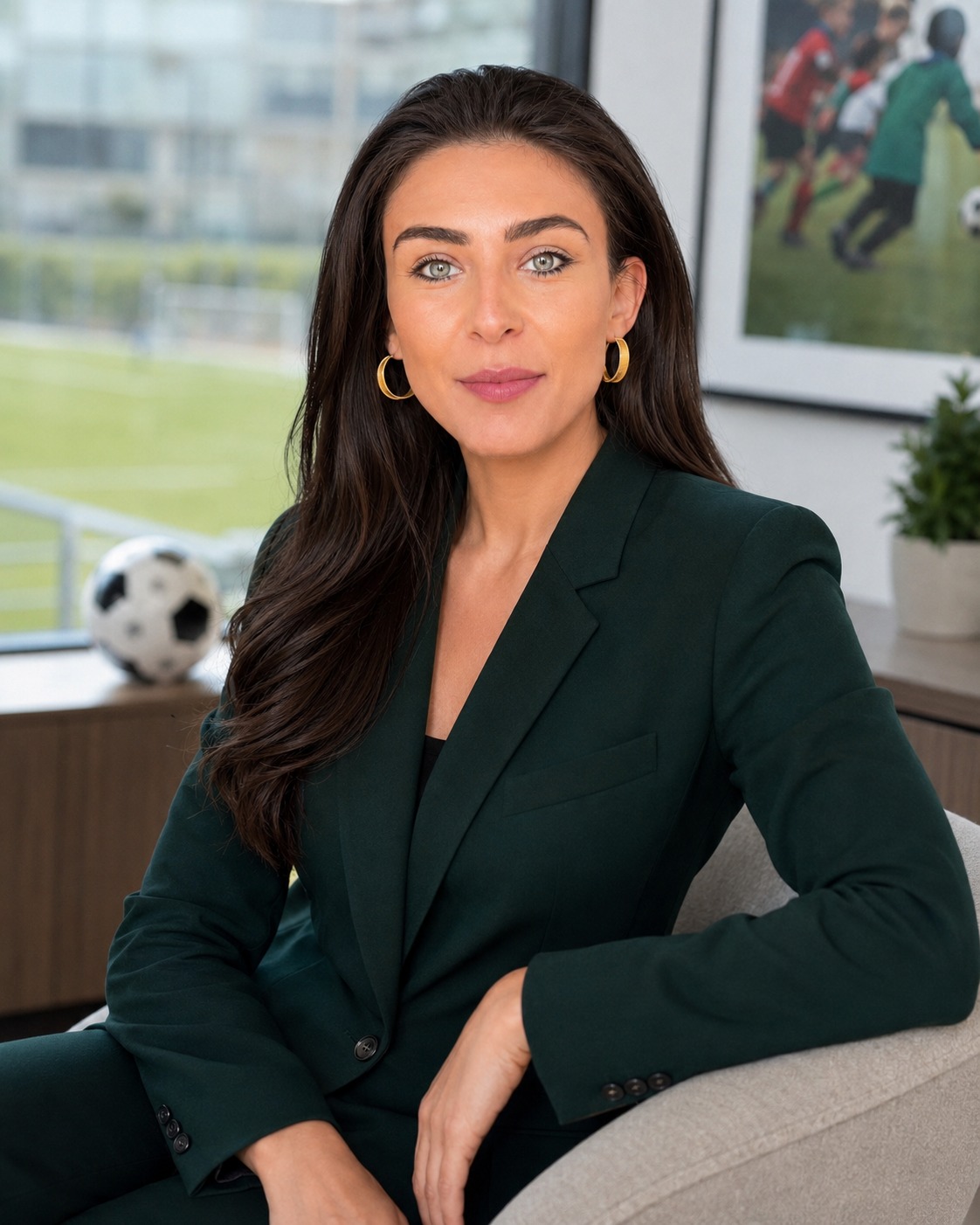
As Head of Community Engagement, Valdez has become one of the Foundation’s most important public voices: calm when the air is noisy, warm when the tournament turns cold, precise when the community needs clarity. At 33, she carries a story that stretches from Los Angeles to New York, from Peruvian family gatherings to Chilean songs in the kitchen, from schoolyard football games on sun-baked asphalt to Hackman Towers, where Los Lambos is monitored with the seriousness of a national institution.
We sat down with Maddie during one of the most turbulent stretches of Los Lambos 2026: Brazil gone, Germany gone, SuperSub Mayhem II upon us, and the Balogun red-card controversy still hanging over the competition like a storm cloud with a legal department.
What follows is a wide-ranging conversation about football, fairness, Gene Hackman, family, identity, music, movies, pressure, and why the Foundation still believes the game belongs to everyone.
Desmond FaheyMaddie, let’s start at the beginning. You were born in Los Angeles?
Maddie ValdezI was. East Hollywood originally, then Glendale for a while. My father was Peruvian, from Lima, and my mother was Chilean, from Valparaíso. That combination meant our house was never quiet. There was always food, football, music, argument, laughter, more football, and then someone reopening an argument that everyone thought had ended three hours earlier.
FaheyThat sounds like ideal training for Los Lambos.
ValdezHonestly, yes. Los Lambos is not as chaotic as my family at a Copa América watch party, but it is close.
FaheyWhich country had priority in the house?
ValdezThat depended entirely on who was winning. My father would tell you Peru was the spiritual center of football. My mother would tell you Chile suffered more beautifully than anyone else. I learned early that football was identity, memory, geography, family pride, and occasionally a reason not to speak to an uncle for a week.
FaheyDid you play?
ValdezConstantly. Not at a high level, but with complete emotional commitment. Schoolyard football, parks, indoor five-a-side, anything. I was a midfielder because I liked being involved in everything. I was not fast enough to be a winger and not patient enough to be a defender. I wanted the ball, I wanted to pass, I wanted to organize, and I wanted everyone to know when they had failed to make the obvious run.
FaheyThat sounds familiar.
ValdezIt is probably why I ended up in community engagement. You spend your life trying to get people into the right spaces at the right time.
FaheyYou moved to New York when you were 15. How big a change was that?
ValdezHuge. Los Angeles is light and sprawl and cars and heat shimmering off pavement. New York felt vertical. It had weight. It had weather that seemed personally annoyed with you. I went from being a kid who knew every street around her to feeling like I had been dropped into a film already halfway through.
FaheyDid football help?
ValdezCompletely. Football gave me a language before I had confidence. I was shy at first in New York, which surprises people now because I spend a lot of time speaking publicly. But football helped me connect. You can be new, awkward, badly dressed for winter, and still belong if you know when to pass and when to shoot.
FaheyYou support a Peruvian club?
ValdezAlianza Lima.
FaheyWhy Alianza?
ValdezMy father. He was Alianza to his bones. He had this old blue-and-white shirt that he treated like a religious artifact. He would talk about Estadio Alejandro Villanueva as if it were both a stadium and a moral universe. When I was little, I thought Alianza was less a football club than a branch of our family.
FaheyDid you inherit that fully?
ValdezYes, but in my own way. I did not grow up in Lima, so I do not pretend my relationship to the club is the same as someone who went every week with their father or grandfather. But Alianza was part of how my dad taught me where he came from. The colors, the songs, the stories, the pride. Supporting Alianza became a way of staying connected to him and to a part of myself that could have felt distant.
FaheyWhat did your mother make of that?
ValdezShe respected it, but she always said Chilean football had better heartbreak. Which, to be fair, is a powerful argument.
Finding the Foundation

FaheyHow did the Gene Hackman Soccer Foundation enter your life?
ValdezThrough youth sport, actually. I studied communications and public policy in New York, then worked with a community sports nonprofit in Queens. We were trying to protect access to playing fields for kids whose schools did not have proper facilities. The Foundation had supported a small equipment and coaching initiative. Not a huge flashy thing. Just cones, bibs, balls, after-school coaching hours, transport help. But it mattered.
FaheyYou saw the Foundation first through grassroots work.
ValdezExactly. Before I knew about the internal mythology, before Hackman Towers, before Los Lambos, before I understood what LLKYA meant, I saw the Foundation as an organization that made sure kids could play. That mattered to me.
FaheyWhat was your first impression of the Foundation culture?
ValdezSerious. Oddly funny, but serious. There was a ceremonial quality to things. People spoke about fairness like it was infrastructure. Not a slogan. Infrastructure. Something you build, maintain, inspect, protect. That stayed with me.
FaheyHow did you move into your current role?
ValdezSlowly, then all at once. I started as a community programs coordinator. That meant local partner work, school outreach, translation support for families, community clinics, lots of unglamorous logistics. Then I moved into public engagement, especially around participation and accessibility. Eventually, as Los Lambos grew and the Foundation’s community became more active, there was a need for someone who could talk to managers, families, supporters, partners, and media without turning every sentence into a compliance memo.
FaheyHolling Vincoeur will be devastated.
ValdezHolling knows what he is. He is a necessary weather system.
FaheyAnd now you are Head of Community Engagement.
ValdezYes. Which means I spend a lot of time asking: who is this for, who feels included, who feels excluded, what do people understand, what do they misunderstand, where is the pressure building, and how do we keep the Foundation human while still being fair?
Gene Hackman
FaheyYou worked under Gene Hackman’s Foundation while he was still alive. What was he like?
ValdezHe had presence. That is the word everyone uses because it is the right word. Presence. He did not need to dominate a room. He simply changed the room by entering it. There was a stillness to him. A kind of deep attention. When he listened to you, you felt he was actually listening, not waiting for his turn to perform wisdom.
FaheyWas he intimidating?
ValdezAt first, yes. How could he not be? He was Gene Hackman. That face, that voice, that history. But he was not cruel with it. He had authority without needing to remind you of it. And he had this dry humor that arrived late in a conversation, like a door opening quietly behind you.
FaheyWhat did he care about most within the Foundation?
ValdezFairness. Access. Dignity. Those three things. He believed football should not belong only to people with money, connections, perfect facilities, or the right zip code. He believed ordinary people deserved extraordinary seriousness. That is one of the most important things about him. He did not patronize communities. He did not say, “Here is a little program for you.” He said, “This matters. You matter. The game matters. We will treat it properly.”
FaheyThat phrase, “football for all and fairness for all,” is now used often inside the Foundation.
ValdezBecause it captures the core. Football for all means access. Fairness for all means standards. You need both. Access without fairness becomes chaos. Fairness without access becomes elitism. Gene understood that.
FaheyDo you miss him?
ValdezYes. And I think a lot of us are still learning how to miss him while continuing the work. Grief can freeze institutions if they let it. The Foundation has chosen movement. Christian Slater has been very clear about that. We honor Gene by advancing the work, not by turning him into a statue that prevents anyone from touching anything.
Los Lambos and the Seriousness of Play
FaheyYou have become one of the Foundation’s public voices around Los Lambos. Why does this competition matter so much?
ValdezBecause it is play treated with dignity. That might sound simple, but it is powerful. People think games are trivial because they are games. I disagree. Games reveal people. They reveal nerve, imagination, loyalty, risk appetite, resilience, ego, humility. Los Lambos is funny sometimes, dramatic often, but it is serious because the people inside it care deeply.
FaheyWhat makes a great Los Lambos manager?
ValdezAdaptability. Everyone can build a beautiful squad before reality touches it. The great managers respond when reality breaks the plan. Germany going out. Brazil going out. A red card. A suspension question. An injury. A shock result. Suddenly the spreadsheet is no longer a spreadsheet. It is a stress test.
FaheyWe are in that kind of moment now.
ValdezAbsolutely. This has been a tournament of ruptures. Brazil exiting after Germany changed the entire emotional shape of Los Lambos. Managers who thought they had structural security now have exposure. Managers who looked buried may suddenly have routes back into relevance. That is why SuperSub Mayhem II matters so much. It is not a little admin window. It is a moment of judgment.
Balogun, Controversy, and the Burden of Fairness
FaheyWe need to ask about the Balogun red card and the quashed suspension. It has caused real debate among managers. What is your view?
ValdezCarefully?
FaheyIdeally.
ValdezThe Foundation understands why managers have strong feelings. A red card is not just a match incident in Los Lambos. It affects points, planning, selection confidence, and perceptions of fairness. When a suspension is then quashed, people naturally ask whether the original consequence should still shape competition outcomes. Those are legitimate emotions.
FaheyBut?
ValdezBut the Foundation has to separate emotion from administration. Our role is not to relitigate football authority decisions based on which managers benefit. We have to apply the Rules of Engagement consistently. If the match event occurred and was recorded for scoring purposes, we process it under the scoring framework. If a governing body later changes disciplinary consequences, we recognize that in the appropriate context, but we cannot allow every external reversal to become a retroactive moral referendum.
FaheySome managers feel that is harsh.
ValdezI understand. I really do. But fairness is not always the same as everyone feeling satisfied. Sometimes fairness is everyone knowing the rules were applied in the same way, even when the result hurts.
FaheyHas the controversy damaged trust?
ValdezI think it has tested trust. That is different. Trust is not proven when everyone is happy. Trust is proven when people are frustrated and the institution still behaves consistently. Holling’s Compliance Unit has been very clear internally: no manager, no player, no national storyline, no leaderboard position gets a bespoke interpretation.
FaheyYou sound sympathetic but firm.
ValdezThat is the job. We are dealing with managers who care. I never want to mock that. But we also cannot run Los Lambos by volume of outrage. If we did, the loudest manager would become the rulebook.
SuperSub Mayhem II
FaheyWhat should managers understand going into SuperSub Mayhem II?
ValdezThat the tournament has changed. Not theoretically. Actually. Germany and Brazil are gone. Other nations have advanced into relevance. Some players who looked peripheral now matter. Some big names are dead weight. Some managers will be tempted to chase yesterday’s points. Others will overreact and cut too deep.
FaheyWhat is the right mindset?
ValdezClear-eyed aggression. That is the phrase I keep using. Be bold, but do not be reckless. Understand the route. Understand minutes. Understand scoring categories. Understand that bringing a player back in who was removed at the last window is allowed, but it still has to make sense. Managers should not treat the window like a panic room. It is a chance to demonstrate control.
FaheyHow much can SuperSub Mayhem II change?
ValdezA lot. Three changes at this stage can transform an active XI. Not because three is a huge number, but because the player pool has become concentrated. The wrong three decisions can finish you. The right three can put you within touching distance of something historic.
FaheyThe Pantheon?
ValdezAlways the Pantheon.
Music, Movies, and the Person Behind the Role
FaheyAway from the Foundation, what music does Maddie Valdez listen to?
ValdezIt depends what version of me you are catching. If I am cooking, it is probably salsa, cumbia, old boleros, Celia Cruz, Héctor Lavoe, Los Ángeles Azules. If I am walking through New York trying to feel cinematic, it might be The Strokes, Yeah Yeah Yeahs, or LCD Soundsystem. If I am homesick for a place that is really a feeling, I listen to Chabuca Granda because of my father.
FaheyAny guilty pleasures?
ValdezI reject the premise. Pleasure is not guilty. But yes, early 2000s pop. Loudly. With no apology.
FaheyFavorite films?
ValdezThat is difficult in this building because film opinions are treated almost as seriously as Los Lambos. But I love The Conversation. I love Dog Day Afternoon. I love Y Tu Mamá También. I love In the Mood for Love. I love Clueless, which I will defend against anyone. And, of course, Gene’s work.
FaheyFavorite Gene Hackman film?
ValdezThe official answer should probably be something grand and serious.
FaheyAnd the honest answer?
ValdezHoosiers means the most to me emotionally. I know it is basketball, not football, but it understands community sport. It understands small places, pride, pressure, and the dignity of people who care. Gene carries that film with such restraint. He makes you believe leadership is not about speeches. It is about standards.
FaheyAny others?
ValdezThe French Connection is monumental. The Conversation is quietly devastating. And I have a deep affection for The Birdcage because it shows his range and because sometimes joy matters.
Christian Slater and the Post-Hackman Era
FaheyWhat has Christian Slater brought to the Foundation?
ValdezClarity. People sometimes misunderstand him because he has charisma and humor, and they assume that means he is casual. He is not casual about this. He understands that he has inherited something emotionally important. He also understands that trying to imitate Gene would be a mistake. He leads differently.
FaheyHow?
ValdezHe is sharper-edged in some ways. More kinetic. He likes momentum. Gene had that stillness I mentioned. Christian has voltage. But they share something essential: respect for the seriousness of ordinary people’s commitments.
FaheyHas he steadied the Foundation?
ValdezYes. Not by pretending nothing changed. Everything changed. Gene is gone. The Foundation felt that. Still feels it. But Christian has helped us move forward without treating forward motion as disloyalty.
Table of Death Rumors
FaheyThere are rumors that this year’s Los Lambos may receive Table of Death status.
ValdezI have heard those rumors.
FaheyCan you comment?
ValdezI can say that any such designation sits far above my office and carries significant procedural and cultural weight.
FaheyThat sounds like a carefully constructed non-answer.
ValdezThank you.
FaheyChristian Slater was asked directly.
ValdezI believe his answer was “No comment.”
FaheyThat has not exactly calmed speculation.
ValdezNo. But sometimes silence is not absence. Sometimes silence is architecture.
FaheyThat sounds ominous.
ValdezLos Lambos has entered an ominous phase.
The Community
FaheyWhat do you want managers and supporters to remember during this stage of the competition?
ValdezThat competition and community are not opposites. You can want to win desperately and still respect the people around you. You can be furious about a decision and still accept process. You can lose players, lose ground, lose certainty, and still stay part of the story.
FaheyWhat has impressed you most about the Los Lambos community?
ValdezThe commitment. People remember details from tournaments years ago. They remember near misses, strange calls, disastrous picks, genius substitutions, table swings. That shared memory makes Los Lambos feel alive. It is not just this year’s competition. It is an accumulating folklore.
FaheyAnd what worries you?
ValdezWhen ambition becomes entitlement. Wanting to win is beautiful. Believing the tournament owes you a particular outcome is dangerous. Los Lambos owes managers fairness. It does not owe them comfort.
Final Thoughts
FaheyLast question. What does football mean to you now?
ValdezIt means belonging. It means my father shouting at a television in Spanish. It means my mother pretending not to care and then caring more than anyone. It means Los Angeles parks and New York winters. It means Alianza Lima. It means kids getting a ball when they did not have one. It means Gene Hackman insisting ordinary people deserved extraordinary seriousness. It means the Foundation trying, every day, to make fairness real.
FaheyAnd that’s where we’ll leave it.
ValdezThank you.